Cagoules for Wet Adventures
A cagoule is a weatherproof pullover type raincoat or anorak with a hood but without front opening. They are ideal for wild splash sports.
Cagoule (kəˈɡuːl) n, also spelled cagoul, kagool, kagoul, or kagoule.
(Clothing & Fashion) a lightweight usually knee-length type of anorak,
named after the French word for hood, "cagoule".
Cag, short for cagoule, is the British word describing a long, hooded, lightweight and weatherproof jacket or pullover, first introduced in the 1960's.
Marketed as a handy fashion accessory,
cagoules became very popular in the United Kingdom during the 1970s as lightweight tops, usually without lining.
We reckon they are still the most practical outfit for wet and wild water sports.
Long Adventure Cagoules
Adventure cagoules are longer than anoraks and reach almost to the knees. The bigger ones go below the knees. This reduces wind chill when you get soaking wet from your water sports.
Unlined cagoules are best for amphibian activities where you go in and out of of the water often. They are easy to swim in and dry quickly. Long sleeves provide cover that stays put during fast activities.
Adventure cagoules often have no zips that get blocked by mud and sand during your adventures. This also means less bulk and weight. Simply pull the draw strings of the hood to close the collar.
Some have a pouch pocket in the chest area with little drain holes to let any water run out.
Small zipped side openings allow quick access to your pants pockets.
Double cuffs seal out moisture.
Design
Cagoules are lightweight tops, usually without lining. The fabric is often an Oxford nylon which is waterproofed with polyurethane, and the seams are taped. Most cagoules are knee-length for better cover.
Some are made from Supplex. Not waterproof, but good wind resistance and very quick drying. If you use it as a "wind tunic" then it is even more versatile as a wind layer in all but the hottest weather, when getting wet isn't dangerous.
As a functional outdoor rain garment, the loose fit styling and proportions allow your small items of personal luggage to be protected, like a rucksack, waist bag and/or camera bag. It is sized to fit over everything, including your pack. In an emergency it can even be used as a bivi shelter.
Some cagoules have a pouch pocket in the chest area. When rolled up, the hood or front pocket doubles as a bag into which the cagoule can be packed.
This is as close to the ultimate in rain protection that you can get.
It also provides excellent cover when worn on a boat or the beach.
Swimming is easy in a cagoule, as many of our readers have told us.
Fabrics
The fabric is often an Oxford nylon which is waterproofed with polyurethane, and the seams are taped. While outdoor clothing manufacturers and the media rave about the breathability of Gore-tex or eVent fabrics, the fact is they work poorly for people who cover up their torso with a backpack, shoulder straps, and hip belts. Water vapor can not move across a breathable fabric efficiently under those circumstances.
The coating that makes these clothes breathable, called DWR for “durable water repellent”, rubs off with use. When that happens, most backpackers buy a new jacket, on average every 2-3 years, instead of trying to restore the DWR coating with a product like Nikwax TX Direct.
Alternatively, many hikers and backpackers buy rain jackets that are made with non-breathable fabrics. Many of those rain jackets have pit-zips and other venting features to help reduce internal sweat build up when it rains.
You don’t need to buy an expensive rain jacket for hiking and backpacking because an inexpensive one will work just as well as one costing an arm and a leg. Most hikers use rain jackets and ponchos that cost $50 or less for just this reason.
Some cags are made from Supplex.
Not waterproof, but good wind resistance and very quick drying.
If you use it as a "wind tunic" then it is even more versatile
as a wind layer in all but the hottest weather, when getting wet isn't dangerous.
It is more versatile in the sense that
Supplex allows you to remain comfortable in extremely wide range of conditions.
This is our go to clothing in summer.
It is cooler then wearing shorts plus a shirt because of the amazing ventilation.
Hoods
Adventure cagoules always have an integral hood to protect head, neck and ears from wind, rain, and sunburn. Without a hood rain would just run off your head and down your collar, soaking your clothes quickly. Same happens when you wear the hood down in the rain. Get used to your hood.
Good fit is important. If it is too large it flaps around in the wind or obstructs your vision. This is even more important when you're swimming as you don't want the hood to fill up with water. A tight fit avoids that.
The hood has one draw cord around the face which reduces water coming in. Another draw cord or velcro strip may go across the back of the head to reduce the overall size of the hood for a better fit.
Better cagoules have a hood with two draw cords, one around the face
and the other across the back of the head to reduce the overall size of the hood for a better fit.
Some cagoules have a hood or pocket that doubles as a bag into which the cag is pushed when stowed.
Make sure to stow it completely dry or it will rot.
Layers
Rainwear may not keep you dry, but can keep you warm by shielding you from wind and rain. Inside forms a warmer micro-climate. Your goal should be to stay warm and avoid hypothermia.
Think of rain clothes as part of a larger layering system to keep you warm, often in combination with a mid or base layer.
A loose fitting outer layer gives you more freedom to move, like a cape or poncho worn over your cagoule. Underneath a quick drying fleece pullover and matching pants will keep you warm on open water swims. Add trekking sandals or robust sports shoes which often add some bouyancy.
Sports clothes are designed to get wet and remain comfy and functional in the water.
They are the base layer you wear next to the skin.
Most are soft and pleasant, some get itchy.
Size and Length
Designed for the rigours of adventure use, cagoules are generously sized to allow layering and maximum freedom of movement. This also provides for better ventilation.
Most cagoules are knee-length for better cover. The longer design should reach below the knees to give you better protection when you get splashed on a boat, walk through a waterfall, or similar wet activities. When you sit down in a wet place it protects your bottom. When it rains, sit down and pull it over your legs for a complete shelter.
As full-length rain garments, cagoules are designed to fit over everything. Some even include your back pack. Specialist cagoules can be used as a bivi shelter in an emergency.
A drawcord at the base of most cagoules lets you pull it up and tie around the waist for better leg movement.
Loosen it and let it go down before you go swimming
or a lot of water collects around the bottom which could be awkward.
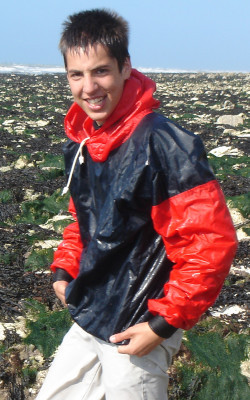
Short canoeing cags keep you warm and avoid windchill during wet and wild splash sports.
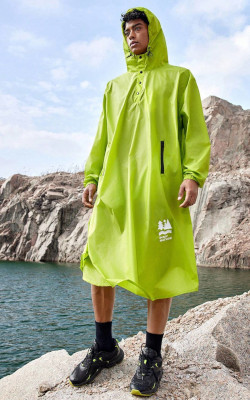
Knee length adventure cagoules are a good compromise when you often go in and out of the water.
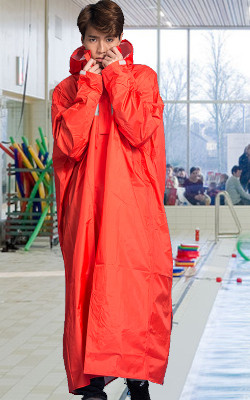
Full length cagoules reach to the ankles for the best cover and keep you warm during swim breaks.
Smock (old term for Cagoule)
A smock-frock or smock was an outer garment traditionally worn by rural workers, especially shepherds and waggoners, in parts of England and Wales from the early 18th century. Made of heavy linen or wool and varies from thigh-length to mid-calf length. It keeps you warm in rough weather.
Today, the word smock refers to a loose waterproof garment worn over your clothing, made from nylon or polyester fabrics. The name smock is still used for some outdoor pullovers. Cheaper than other forms of outer garments, they are both durable and washable.
Smocks are similar to canoeing cags or anoraks but of a simpler design. With matching trousers they prevent cold air and water passing through. Most are shorter than a long cagoule, thus better for active water sports and open water swimming.
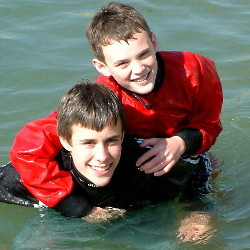
The compact smock design makes water play more fun.
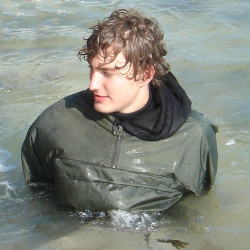
Olive green cagoules are best for nature watching.